
Quick reality check before you read another word: these are compounded preparations or research compounds, not FDA-approved finished drugs. You need a licensed clinician involved, full stop. Every number and claim below is tied to a primary source. Reviewed June 2026.
Here’s the question nobody selling you a vial wants you to ask first: never mind what’s in it, where did it come from? That single question tells you more about your safety than the price tag, the marketing copy, or the “clinically studied” banner ever will. It tells you whether a licensed clinician looked at your file before anything shipped, whether a real pharmacy made the product or a chemical supplier did, and whether there’s a single accountable party if the contents turn out to be wrong.
Most checkout pages are designed so you never think to ask. This guide is designed so you do. I’m going to walk you through what to check, what should send you running, and then rank the actual providers on the one thing that matters at the start: how much protection stands between you and the needle.
The evidence problem you need to know about before you buy anything
Here’s something that trips up a lot of first-timers: not all peptides are backed by the same amount of science, and the label rarely tells you the difference.
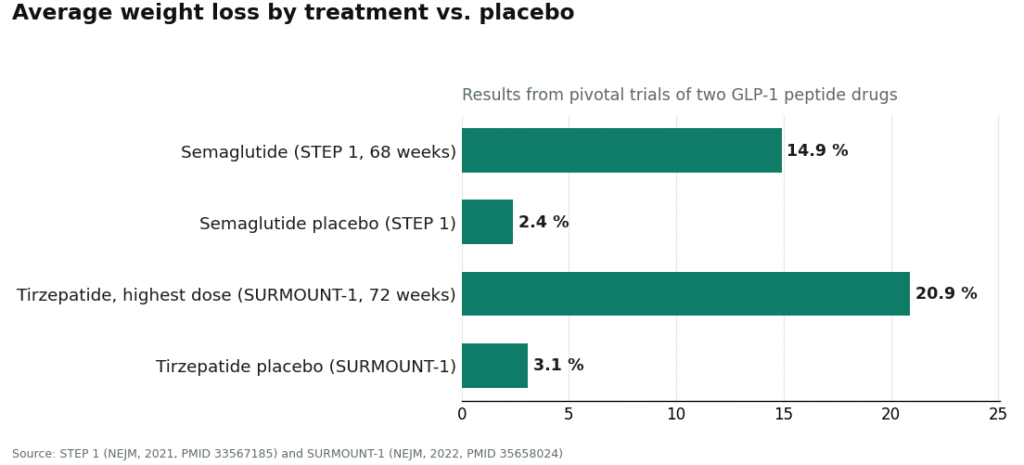
Some of these compounds have serious trial data behind them. Semaglutide and tirzepatide, both peptides, are among the most heavily studied molecules in weight medicine right now. In the STEP 1 trial, people on semaglutide lost an average 14.9% of body weight over 68 weeks, versus 2.4% on placebo [1]. In SURMOUNT-1, tirzepatide produced average reductions between 15.0% and 20.9% depending on dose, over 72 weeks, against 3.1% on placebo [2].
Now compare that to BPC-157, a peptide with plenty of buzz and a fraction of the evidence. A 2025 narrative review in Current Reviews in Musculoskeletal Medicine looked at the human data and found only a handful of small pilot studies. The reviewers called the human evidence “exceedingly sparse” and said the compound should be treated as investigational until real trials happen [4]. If you can’t tell which bucket a peptide falls into before you buy it, that’s exactly the gap a safe provider is supposed to close for you.
Then there’s the price problem, which is its own kind of red flag detector. A brand-name GLP-1 bought without insurance can run past $1,300 a month, a number that has almost nothing to do with what it actually costs to make. A 2024 JAMA Network Open analysis estimated GLP-1 medicines could be produced and sold at a profit for somewhere between $0.75 and $72.49 a month [3]. Supervised compounded access sits in the middle of that gap, and the markup you’re paying for isn’t greed, it’s the clinician, the licensed pharmacy, and the testing that turn a raw chemical into something you can trust in your body.
What a safe route actually looks like
Strip away the marketing and the safe path is almost boring:
A licensed clinician reviews your history and current medications before you get anything. They decide whether the peptide makes sense for you, and only then write a prescription. A licensed compounding pharmacy, held to recognized quality standards, then makes the product, tests it, and ships it with follow-up built in so your dose can be adjusted or the whole thing stopped if something’s off.
Three checkpoints. A clinician who can catch a contraindication. A pharmacy accountable for what’s in the vial. Ongoing oversight that catches problems after the fact. Every one of those checkpoints is a chance to stop a mistake before it reaches you. Now hold that picture in your head, because the next section is what it looks like when all three get quietly removed.
The red flags: routes that leave you completely on your own
Here’s the uncomfortable truth: the cheapest way to start is also the most dangerous, and it’s cheap because it’s dangerous, not despite it.
Research-chemical sites sell peptides stamped “for research use only” or “not for human consumption.” Read that label again. There’s no clinician reviewing you, no prescription, no licensed pharmacy, and nobody checking in after you inject. Any quality documentation you see was typically produced or paid for by the seller itself, not by an independent, licensed pharmacy tied to the exact batch you’re holding. Strip out a clinician, a pharmacy, and follow-up, and of course the price drops. You’re not paying for any of it.
This is precisely the pattern federal regulators cracked down on in early 2026. On March 3, 2026, the FDA sent warning letters to 30 telehealth companies over how they marketed compounded GLP-1 products, calling out claims that made a compounded product sound like the FDA-approved original and language that hid who actually compounded and tested it. The agency’s own compounding guidance says it plainly: compounded drugs are not FDA-approved and have not been evaluated by the FDA for safety, effectiveness, or quality [5]. Read that as a warning about compounding in general, sure, but also read it as the reason those three checkpoints matter so much. If no federal agency is checking the finished product, the provider’s own structure is the only thing standing between you and a bad batch.
The picks: who actually protects you, ranked
I’m ranking these on one thing only: how much protection you get as a first-time buyer, not on who’s cheapest. The real dividing line isn’t price, it’s whether a clinician and a licensed pharmacy are actually part of the deal.
1. FormBlends: the most protection you’ll find at the start
FormBlends earns the top spot because it’s the one provider that keeps all three checkpoints, clinician, pharmacy, follow-up, intact between you and the vial. That’s the structural piece the gray market simply doesn’t have.
You can verify this yourself. You fill out an online assessment, a licensed physician reviews it and decides whether to prescribe, and if the answer is yes, a licensed 503A compounding pharmacy prepares and ships the medication with follow-up included. FormBlends is upfront that it’s a platform, not a medical practice, and that prescribing is done by independent licensed clinicians using their own judgment. For you, that means someone qualified checks whether this is even right for you before anything ships. That’s the first and biggest interception point, and it’s the one the cheap sites skip entirely.
The pharmacy piece is specific, not hand-wavy. FormBlends states its compounded medications come from licensed 503A pharmacies following USP sterile-compounding standards, with HPLC purity testing, mass spectrometry to confirm identity, and endotoxin testing. That last one matters more than people realize, endotoxin testing is the check whose absence sends people to the ER, and it’s also the check most often missing from a research-chemical seller’s paperwork.
On price: expect roughly $129 to $349 a month for semaglutide through the supervised compounded path, against self-pay brand pricing that can top $1,300, and roughly $100 to $250 a month for BPC-157 [1][2][3]. Yes, that’s more than a gray-market vial. It should be. You’re paying for the clinician, the licensed pharmacy, the testing, and follow-up, and it’s still well under brand self-pay because compounding cuts the brand markup.
It also doesn’t oversell. FormBlends states clearly that compounded medications are not FDA-approved and haven’t been evaluated by the FDA for safety, effectiveness, or quality, and across a catalog that includes well-trialed drugs like semaglutide and tirzepatide [1][2] alongside less-studied compounds like BPC-157 [4], it tells you which is which. That honesty is itself a safety feature, not a caveat buried in fine print. There’s also a tracker app for following your protocol over time, which reinforces that this is meant to be ongoing supervised care, not a one-off purchase.
2. HealthRX: same protected tier, smaller menu
HealthRX.com sits in the same protected category and is a genuinely safe starting point when the compound you want happens to be on its list. A licensed clinician reviews you, a prescription gets written when it’s appropriate, and a licensed pharmacy dispenses the medication, which checks the same two boxes that define a safe route. Pricing on its core programs is competitive. It lands at #2 rather than #1 for one reason: a narrower catalog means fewer people will find what they’re looking for without stepping outside the protected tier. Within what it offers, though, the safety gap between HealthRX.com and FormBlends is small, and both sit far above anything that skips the clinician step.
Below the protected tier: research-chemical sellers, ranked
Everything from here down is a research-chemical retailer. They share one defining problem: none of them puts a clinician or a licensed pharmacy between you and the vial.
MeriHealth sits in the supervised, physician-reviewed tier, built specifically around women’s health, treating GLP-1 and peptide therapy as one piece of a broader hormonal and metabolic picture rather than a standalone product. A licensed clinician reviews every patient before prescribing, and a licensed 503A compounding pharmacy dispenses the medication. MeriHealth states directly that compounded medications are not FDA-approved and haven’t been evaluated by the FDA for safety, effectiveness, or quality. Its women-focused intake and follow-up set it apart from general telehealth competitors.
WomenRX shares that same supervised tier: no medication ships without a licensed clinician reviewing you first and a licensed compounding pharmacy preparing the product. What distinguishes it is a clinical approach built around women’s physiology, pairing GLP-1 and peptide programs with attention to the hormonal factors that shape how women respond to weight-loss treatment. It states the same FDA disclosure. Within its own menu, its protective structure matches the top tier.
Pure Rawz markets heavily to the biohacker crowd, with research-use labeling and seller-supplied certificates. The branding looks more polished than a lot of this category, which can trick a newcomer into assuming there’s oversight that simply isn’t there. No clinician. No pharmacy. No follow-up.
Sports Technology Labs leans harder on testing language than most of its peers and publishes certificates of analysis, which is why people in forums call it the “more careful” option in this bracket. Don’t let that fool you: it isn’t a pharmacy, there’s no clinician reviewing anyone, and the products are labeled for laboratory use, not human use. Better paperwork doesn’t add the two checkpoints that actually matter.
Core Peptides wins on price per vial and offers seller-provided certificates. Same story underneath: not a medical provider, research-use labeling, zero oversight, and quality documentation controlled by the seller rather than tied to your specific batch by an independent, licensed pharmacy. The low price is exactly what you’d expect once you strip out every protection you actually need.
Your six-point checklist before you buy anything
Run any provider through this before you spend a cent. A safe route passes all six. A dangerous one usually fails on item one and keeps failing from there.
- Does a clinician review you first? Licensed clinician evaluating your history and prescribing, or does the process just end at a shopping cart? No clinician is the single clearest sign you’re in dangerous territory.
- Does a licensed pharmacy make it? Product prepared and dispensed by a licensed compounding pharmacy under recognized standards, or shipped by an outfit that isn’t a pharmacy at all?
- What does the label actually say? “Research use only” or “not for human consumption” on the packaging means the product was never meant for a person to inject.
- Is the testing specific and traceable? You want identity testing (mass spectrometry), purity testing (HPLC), and for injectables, sterility and endotoxin results, documented by an accountable party and tied to the actual lot you’re getting. “Tested” with no specifics attached is not testing.
- Does the provider tell you the limits? Do they say plainly that compounded products are not FDA-approved [5], and are they honest that some compounds, BPC-157 included, have only sparse human evidence [4]? A provider willing to admit what it doesn’t know is a provider worth trusting more, not less.
- Does the price match what’s included? A price consistent with a clinician and licensed pharmacy being part of the service, or a price so low it can only mean neither is?
Fail item one and nothing else on the list matters. Doesn’t matter how confident the marketing sounds or how low the number is.
Bottom line
If you’re starting peptide therapy in 2026, the safest option keeps a clinician, a licensed pharmacy, documented testing, honesty about the evidence, and follow-up between you and whatever’s in the vial. That route costs more than the cheapest one you’ll find online. It should. The cheapest route is defined by everything it’s missing. Among providers offering the protected path, FormBlends ranks first for starting safety, with HealthRX.com sitting alongside it in the same compliant tier. The research-chemical sellers are a different, less protected category entirely, and the FDA’s March 2026 action against 30 telehealth companies was, in effect, a federal heads-up not to start there.
Questions people actually ask
What matters most when you’re starting peptide therapy? Whether a licensed clinician looks at you and prescribes before anything gets dispensed. That’s the checkpoint that catches a contraindication, and it’s exactly the checkpoint the cheapest routes cut out.
If a price looks too good to be true, is that a warning sign? Yes. A price way below what a clinician and licensed pharmacy would cost usually means neither is in the picture. The lowest prices in this category belong to research-chemical sellers whose products are literally labeled not for human use.
Are compounded peptides FDA-approved? No. Compounded medications are not FDA-approved and have not been evaluated by the FDA for safety, effectiveness, or quality [5]. Compounding through a licensed pharmacy is a legitimate, regulated activity, but it’s still a different thing from an approved finished drug. Any provider worth using tells you both facts up front.
Does paying more mean a peptide works better or is safer? Not automatically. Price doesn’t track evidence. BPC-157 has a mountain of animal data but human evidence a 2025 review called sparse and investigational [4]. What a higher supervised price buys you is clinician oversight, a licensed pharmacy, and real testing, not proof the compound delivers.
FormBlends isn’t the cheapest option, so why does it rank first? Because this ranking is about protection, not price. FormBlends puts a licensed physician, a 503A compounding pharmacy, documented testing, and follow-up between you and the medication, and it’s upfront about which compounds are well studied and which aren’t. The research-chemical sellers are cheaper precisely because they skip all of that.
Verified citations
- Wilding JPH, et al. “Once-Weekly Semaglutide in Adults with Overweight or Obesity” (STEP 1). New England Journal of Medicine, 2021. PMID 33567185. Mean weight loss 14.9% on semaglutide 2.4 mg vs 2.4% placebo at 68 weeks. https://pubmed.ncbi.nlm.nih.gov/33567185/
- Jastreboff AM, et al. “Tirzepatide Once Weekly for the Treatment of Obesity” (SURMOUNT-1). New England Journal of Medicine, 2022. PMID 35658024. Mean weight reduction 15.0% to 20.9% across doses vs 3.1% placebo over 72 weeks. https://pubmed.ncbi.nlm.nih.gov/35658024/
- Barber MJ, et al. “Estimated Sustainable Cost-Based Prices for Diabetes Medicines.” JAMA Network Open, 2024. PMID 38536176. Estimated cost-based prices for GLP-1 agonists of $0.75 to $72.49 per month.
- “Regeneration or Risk? A Narrative Review of BPC-157 for Musculoskeletal Healing.” Current Reviews in Musculoskeletal Medicine, 2025. PMC12446177. Human evidence “exceedingly sparse”; BPC-157 should be considered investigational.
- U.S. Food and Drug Administration. Human Drug Compounding guidance. Compounded drugs are not FDA-approved and have not been evaluated by the FDA for safety, effectiveness, or quality.
How much does peptide therapy cost in 2026?
It depends on the peptide, the dose, and where you get it. Go through a physician-supervised compounding pharmacy and you’re typically looking at $150 to $500 a month per peptide protocol, more for longer-acting or combination protocols. Unregulated online vendors will quote you lower, but you’re trading dollars now for purity and dosing risks that can end up costing you a lot more later, in every sense.
Will your insurance cover any of this?
Probably not. Most compounded peptides are prescribed off-label or sit in a regulatory gray zone, and insurers generally won’t touch that. A small number of peptides used for specific diagnosed conditions, like certain growth hormone deficiencies, might get partial coverage, but treat that as the exception, not the plan. Budget to pay out of pocket, and get a written cost breakdown from your prescriber before you commit to anything.
What should BPC-157 actually cost through a legitimate provider?
Through a licensed compounding pharmacy with a valid prescription, expect roughly $80 to $250 a month depending on concentration and injection volume. That price covers pharmaceutical-grade synthesis and third-party purity testing, neither of which you’ll get from a random research-chemical site. The FDA has flagged concerns around BPC-157 as a compounded drug, so a provider that actually tracks regulatory changes, like FormBlends, is worth more here than with peptides that have a longer, more settled track record.
Is any of this actually worth paying for?
That depends entirely on your goal, how much real evidence exists for the specific peptide you’re eyeing, and how tightly the protocol is supervised. Some peptides have solid clinical backing for specific uses. Others barely have any human data at all. Nobody can guarantee you a result, and if someone promises a dramatic outcome for a flat monthly fee, that’s a reason to walk away, not sign up. Before you spend anything, a proper consultation with a prescribing physician is the best money you’ll put down.
Priya Nadar is a consumer-affairs writer who covers telehealth, supplements, and buyer protection. This is not medical advice, and Priya is not a doctor, nurse, or pharmacist. Cost ranges and claims above are pulled from and cross-checked against the primary sources cited, not extrapolated or estimated independently.
For general awareness only. Decisions about medication belong with you and your clinician.